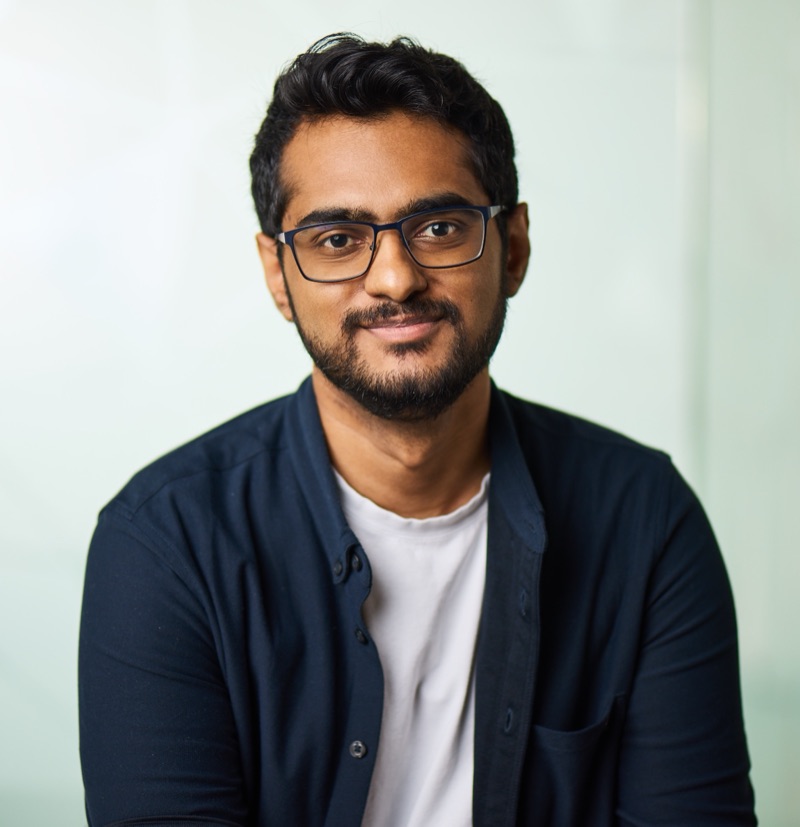
person Siddharth Karamcheti
work Assistant Professor, School of Interactive Computing, Georgia Tech
calendar_month October 23, 2026
schedule 11:00 am - 12:00 pm
pin_drop TSRB Auditorium (118)
(Hosted by DCL)
Ambient Robotics: New Directions for Human-Robot Collaboration
Abstract
Robot learning defines itself with a binary: did the robot complete the task or not? The field has followed that definition through increasing amounts of data and scale in pursuit of full autonomy, treating humans as collectors or evaluators standing outside the system we eventually deploy. This is in stark contrast to the technologies that have genuinely reshaped daily life — search engines, recommendation systems, coding assistants — systems that we evaluate based on how they work alongside people. In this talk, I will present my group’s vision for a paradigm we call “ambient robotics” where the core unit we optimize is the human-robot pair. I will describe early work along three threads: policies that expose a robot’s intended future early enough for a person to edit it, interfaces through which a robot signals what it will not attempt and why, and evaluations that measure the pair’s throughput and the trust built across an interaction rather than per-task success.
Biography
Siddharth Karamcheti is an Assistant Professor in the School of Interactive Computing at Georgia Tech where he directs the CHORD Lab. He received his bachelor’s degree in Computer Science and Literary Arts from Brown University in 2018, and a Ph.D. in Computer Science from Stanford University in 2025. His research focuses on robot learning, multimodal machine learning, and human-robot interaction, with a goal of developing scalable approaches for human-robot collaboration. During his research career he has worked at multiple leading industry labs, including Facebook AI Research, Hugging Face, the Toyota Research Institute, and most recently as the Autonomy Research Lead at Walden Robotics. He is a recipient of the Open Philanthropy AI Fellowship (2018), is an RSS Pioneer (2024), and his research has won paper awards at conferences such as RSS, CoRL, ICRA, and ACL.