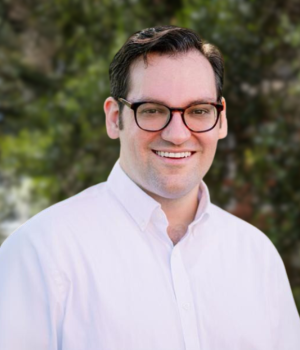
person James Fairbanks
work Assistant Professor, Department of Mechanical and Aerospace Engineering, University of Florida
calendar_month September 11, 2026
schedule 11:00 am - 12:00 pm
pin_drop TSRB Auditorium (118)
(Hosted by DCL)
Sheaves for Coordination Problems in Distributed Autonomous Systems
Abstract
Complex systems of multiple autonomous agents are widely deployed to conduct missions and solve problems. Coordination in these systems is critical to their ability to successfully achieve their goals. Techniques for coordination in multi-agent systems are diverse and highly specialized, often utilizing purpose-built solvers or controllers with tight coupling to the types of systems involved or the coordination goal. This talk will introduce a general unified framework for heterogeneous multi-agent coordination using the language of cellular sheaves and nonlinear sheaf Laplacians, which are generalizations of graphs and graph Laplacians. Specifically, we will introduce the concept of a nonlinear homological program encompassing a network, a system of linear equations on that network, and local optimization objectives, which constitutes a standard form for a wide class of coordination problems.
This standard form leads to distributed optimization algorithms for solving these nonlinear homological programs. To demonstrate the applicability of this framework, we show how heterogeneous coordination goals including combinations of consensus, formation, and flocking can be formulated as nonlinear homological programs and provide numerical simulations showing the efficacy of this distributed solution algorithm.
Biography
James Fairbanks (CSE ’16) is an assistant professor at the University of Florida in the department of Mechanical and Aerospace Engineering, and affiliated with the Institute for Computational Engineering, and the Florida Institute for National Security. Prior to joining UF, James was a senior research engineering at GTRI in the Information and Communications Laboratory where he worked on machine learning and high performance data analytics software for automation in sensing, planning, and scientific modeling. His PhD research at Georgia Tech Computational Science and Engineering focused on numerical, statistical, and streaming methods for graph analytics and network science.
His research focuses on new paradigms in scientific computing, specifically applied category theory and computational sheaf theory. This approach to mathematical modeling focuses on structure and structure preserving relationships between mathematical objects. The GATAS lab at UF studies these topics and supports software-focused research in the AlgebraicJulia Ecosystem. He collaborates widely across the college of engineering and with external collaborators at Georgia Tech, NIST, AFRL, and the Topos Institute.