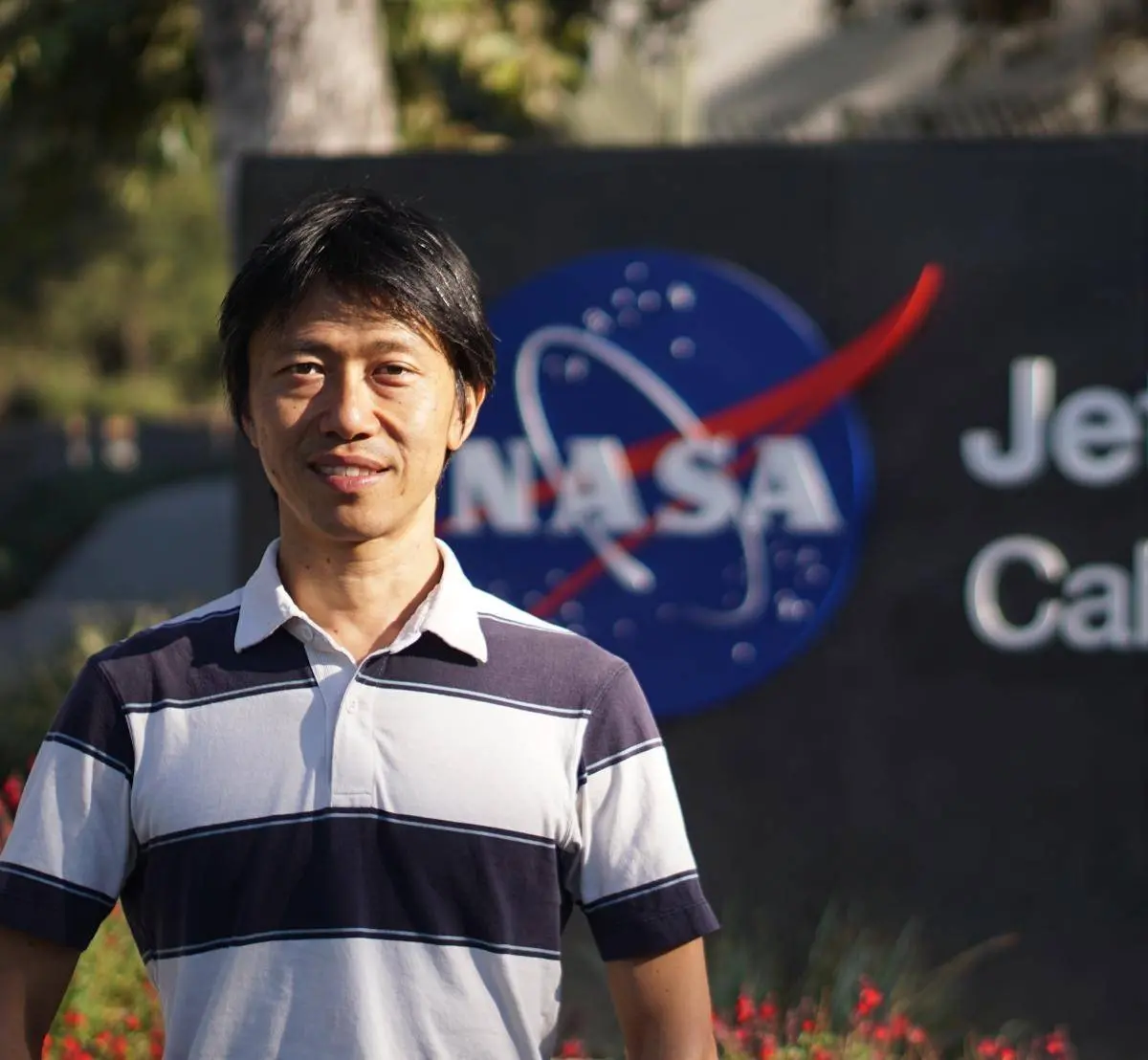
person Hiro Ono
work Associate Professor, Daniel Guggenheim School of Aerospace Engineering, Georgia Tech
calendar_month September 18, 2026
schedule 11:00 am - 12:00 pm
pin_drop TSRB Auditorium (118)
(Hosted by DCL)
Autonomous robotic mobility for planetary exploration: From the surface of Mars to the subsurface ocean of Enceladus
| Link to Slides |
|---|
Abstract
Planetary exploration robots must operate in environments that are remote, uncertain, and fundamentally unforgiving. Communication delays preclude continuous human control, terrain and environmental conditions are only partially known in advance, and a single mobility failure can end a mission. Autonomous mobility is therefore not merely a convenience, but a key enabling capability for extending robotic exploration into increasingly challenging planetary environments.
In this talk, I will discuss the development of autonomous robotic mobility technologies across a spectrum of planetary exploration problems. I will first describe the Enhanced AutoNav (ENav) algorithm that has been successfully driving NASA’s Perseverance Mars rover since 2021. I will then discuss the limitations of ENav, and introduce existing research efforts to remove the limitations mainly through the applications of machine learning, as well as ongoing efforts to incorporate foundational AI into future space systems.
However, of course, Mars is not the end goal of human’s endeavor to space. Rather it is just a beginning. In the second part of the talk, I will introduce EELS—the Exobiology Extant Life Surveyor—a highly articulated snake-like robot developed at NASA’s Jet Propulsion Laboratory to enable the exploration of the subsurface ocean of Enceladus, a small icy moon of Saturn, which may host alien life. EELS is designed to autonomously traverse complex, poorly characterized terrain, including ice, steep slopes, and confined subsurface passages. Finally, I will discuss the ongoing efforts to further robustly icy world locomotion through whole-body tactile sensing.
Across these examples, I will highlight common challenges at the intersection of robotics, autonomy, and AI: how to make decisions with incomplete information, how to balance safety and exploration efficiency, and how robotic systems can remain capable and resilient when operating far beyond the reach of direct human intervention.
Biography
Dr. Masahiro (Hiro) Ono is an Associate Professor at the Daniel Guggenheim School of Aerospace Engineering at Georgia Tech and Director of the Planetary Robotics Lab (PRL). Prior to joining Georgia Tech, he spent 13 years at NASA’s Jet Propulsion Laboratory (JPL), where he developed autonomous navigation algorithms for the Perseverance Mars rover, led the development of EELS (Exobiology Extant Life Surveyor)—a snake-like robot designed to explore the potentially habitable subsurface ocean of Enceladus—and led multiple research initiatives in AI and robotics. He also served as Supervisor of JPL’s Robotic Surface Mobility Group and as a rover operator for Perseverance. Before JPL, he was on the faculty at Keio University in Japan. Dr. Ono is also the author of three books for young readers, and a father of a rebellious princess and a mischievous munchkin. Go Hanshin Tigers.