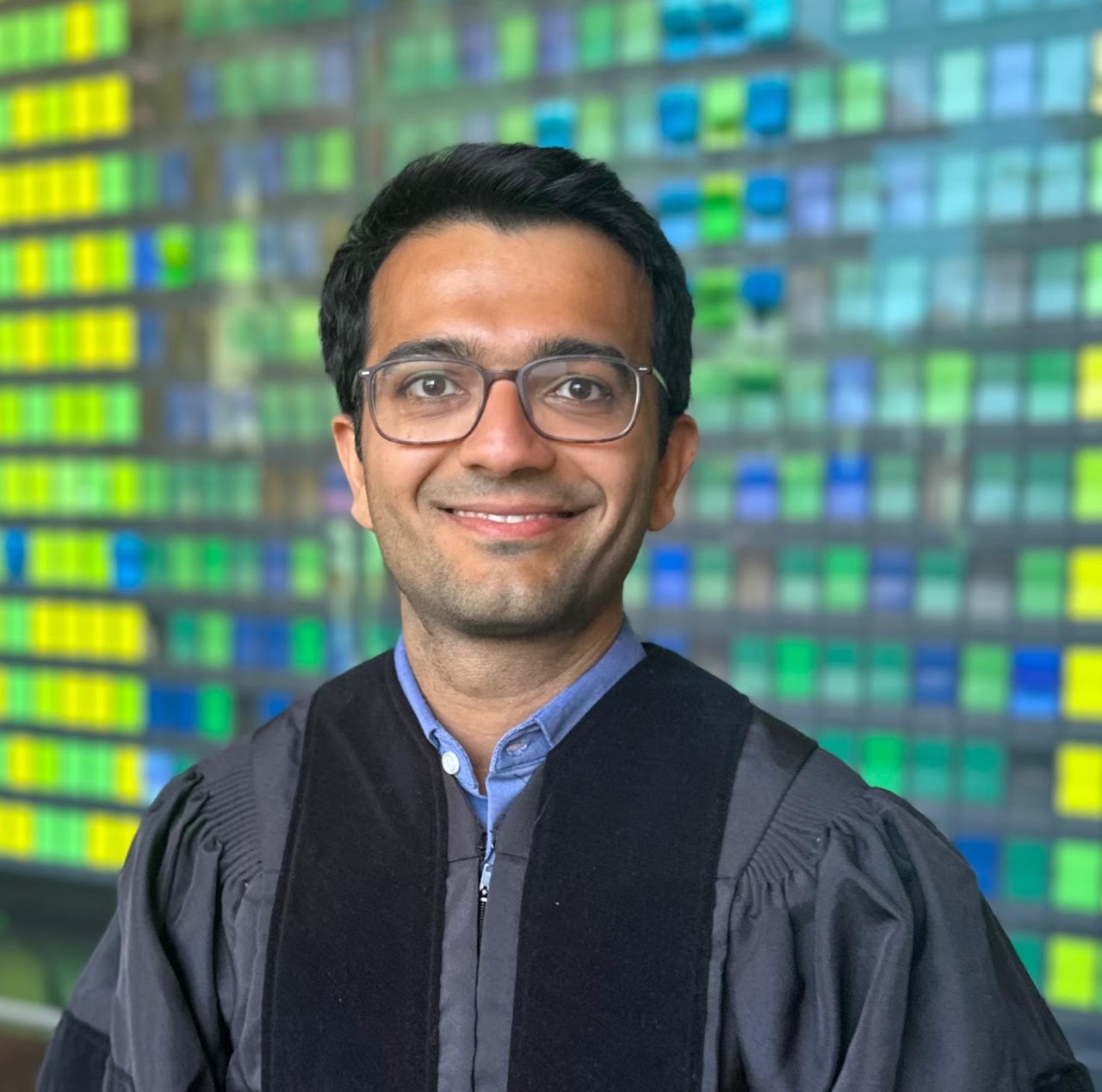
person Devansh Jalota
work Assistant Professor, School of Industrial and Systems Engineering, Georgia Tech
calendar_month October 9, 2026
schedule 11:00 am - 12:00 pm
pin_drop TSRB Auditorium (118)
(Hosted by DCL)
Toward Practical Congestion Pricing
Abstract
Congestion pricing has emerged as an effective tool for mitigating traffic congestion. However, its real-world adoption has been limited by fairness concerns, as low-income users may be priced out of certain roads. Moreover, even in settings where congestion pricing has been implemented, time-varying and congestion-dependent welfare- or revenue-optimal dynamic tolls have proved impractical. Instead, many real-world congestion pricing deployments, including New York City’s recent program, rely on significantly simpler, often static, tolls. In this talk, I present two complementary approaches toward more practical and publicly acceptable congestion pricing design. First, I introduce a convex optimization framework, based on a novel interpolated traffic assignment problem, for designing tolls that explicitly balance efficiency and fairness in traffic routing. Second, I study the gap between simple static tolls and optimal dynamic pricing in two canonical traffic equilibrium models and show through worst-case guarantees and data-driven case studies that static tolls can retain nearly all the benefits of dynamic tolling. Together, these results highlight the practical effectiveness of simple, operationally feasible static tolls and show that well-designed congestion pricing can simultaneously advance the efficiency and equity goals of sustainable transportation.
Biography
Devansh Jalota is a Jerry and Harriet Thuesen Early Career Professor and Assistant Professor in the School of Industrial and Systems Engineering at Georgia Tech. His research blends ideas from operations research, economics, and computer science to develop data-driven algorithms and incentive schemes for socially responsible market design, with a particular focus on applications in future mobility systems and electricity markets. His research has been featured in prominent outlets including The New York Times, recognized through competitive fellowships such as the Stanford Interdisciplinary Graduate Fellowship, and received multiple recognitions at the INFORMS Annual Meeting. Prior to joining Georgia Tech, he was a Postdoctoral Research Scientist at Columbia University’s Data Science Institute. He received his PhD in Computational and Mathematical Engineering from Stanford University and earned a BS in Civil and Environmental Engineering and a BA in Applied Mathematics from the University of California, Berkeley.